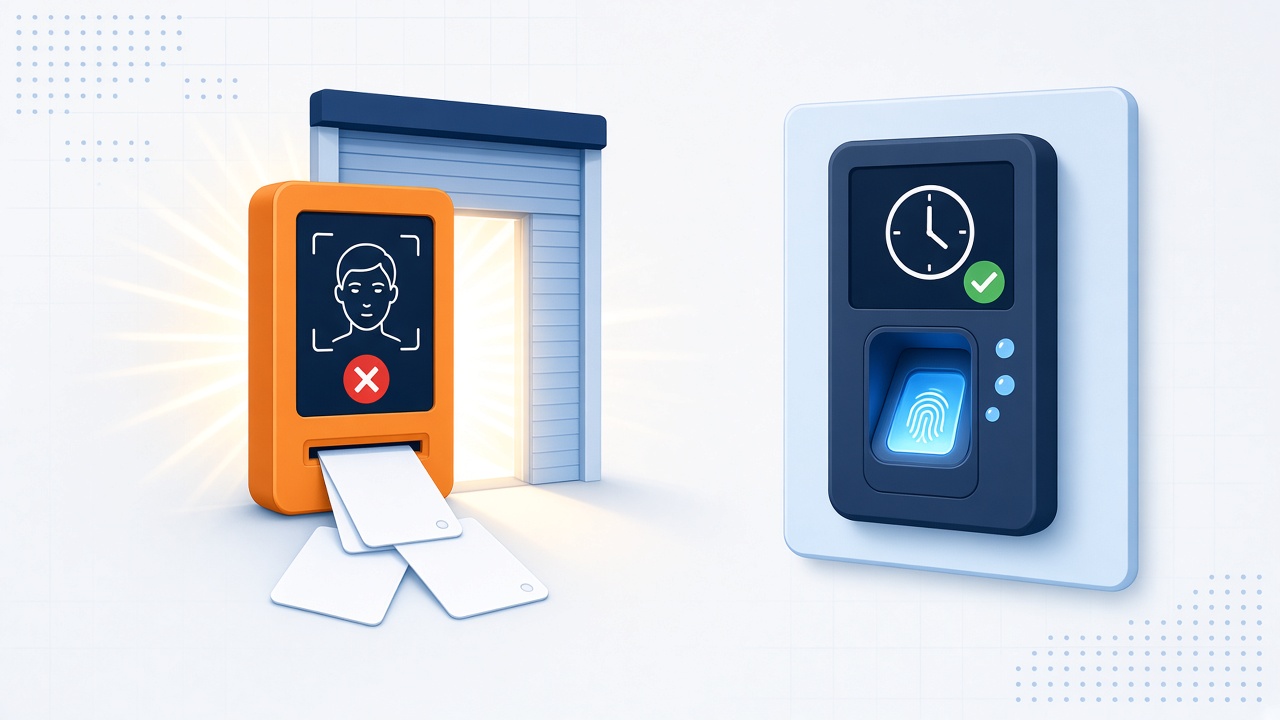
Face Recognition vs Fingerprint Clocking: An Honest View for South African Workplaces
Published: 15 October 2026
An honest technical view from people who have spent more than 30 years installing clocking hardware in South African workplaces
Face Recognition Looks Like the Future
Face recognition terminals are impressive to watch. There is nothing to touch, the demo is quick, and most of us already unlock our phones with our faces.
It is easy to understand why businesses ask us for them.
We get asked regularly. And our answer often surprises people: for most South African workplaces, we still recommend fingerprint.
That is not because we are stuck in the past. It is because we have seen what happens after the installer leaves.
Every Face Terminal Has a Fallback. Ask Why.
Look at the specification sheet of almost any face recognition terminal sold for Time & Attendance. You will almost always find a card reader, a PIN pad, or both.
Suppliers include a fallback because they know face recognition will not work for every employee, every time. In South African conditions, two issues come up again and again: light and skin tone.
Problem One: Light Inside a Real Building
A face recognition terminal is a camera. It can only work with the light that bounces off a person's face. When the light changes, the picture changes.
Think about a typical factory entrance. On the morning shift, the sun shines through the open roller door behind the employee. In the afternoon, there are shadows. On the night shift, there are only fluorescent lights overhead. It is the same face, but three very different pictures.
Researchers have understood this problem for decades. A well-known 1997 study by Adini, Moses and Ullman found that the differences between images of the same face under different lighting were almost always larger than the differences between the faces of different people [1].
Modern algorithms are far better than they were in 1997. But the physics has not changed: a camera cannot recognise what it cannot see clearly.
The US National Institute of Standards and Technology (NIST) saw exactly this when it tested face recognition on border-crossing photographs. Failure rates were higher for travellers born in Africa. When NIST inspected the images, it found "underexposure of dark skinned individuals often due to bright background lighting" [2].
Replace "border crossing" with "factory entrance with a bright doorway behind the employee", and you have a scene we see almost every week.
Problem Two: Skin Tone and Image Quality
People often tiptoe around this subject. But it is a measurable technical issue, not an opinion.
Darker skin reflects less light. When the lighting is not ideal, the camera captures less facial detail, and matching becomes harder. The research is consistent:
- NIST's ongoing face recognition evaluation says that failures to recognise a registered person are strongly dependent on image quality. It gives "inadequate lighting or under-exposure of dark-skinned individuals" as an example [3].
- A US Department of Homeland Security study tested 11 commercial face systems on 363 people. Skin reflectance had the strongest effect of all the demographic factors measured. Darker skin meant slower transactions and lower match scores [4].
- MIT's Gender Shades study found that two widely used benchmark face datasets were 79.6% and 86.2% lighter-skinned. Commercial systems misclassified darker-skinned women up to 34.7% of the time, against a maximum of 0.8% for lighter-skinned men [5]. That study tested gender classification rather than identity matching, but it shows how much the data a system learns from affects its results.
To be fair, the same research shows that the best systems have narrowed this gap considerably. In the Department of Homeland Security study, the effect was almost negligible for the most accurate system [4].
And that is exactly the point. Performance depends heavily on the camera, the algorithm and the lighting. A wall-mounted clocking terminal at a loading bay is not a border-control system in a controlled booth. In a country where most of the workforce has darker skin, that margin is not a minor footnote.
Problem Three: The Fallback Becomes the System
This is the problem that concerns us most, and you will not find it on any specification sheet.
When face recognition fails, the supplier's answer is simple: let the employee use a card. It sounds reasonable. But watch what happens next.
Employees quickly learn that the face scanner does not always work, and that when it fails, they can use a card. Then they learn something else: it is very easy to make face recognition fail. Stand slightly to one side. Look down. Wear a cap. Step too close.
Within a few weeks, a supervisor who is tired of queues at shift change tells everyone to just use their cards.
Now you have an expensive face recognition terminal working as a card reader. And cards can be lent to a colleague. Buddy clocking, the very reason you invested in biometrics, is back.
A biometric system is only as strong as its weakest clocking method. If employees can choose the fallback, eventually most of them will.
This is not theory. We have clients who installed face recognition, ended up with most of their workforce clocking on cards, and came back to fingerprint terminals.
Why We Still Recommend Fingerprint
A fingerprint scanner does not depend on the lighting in the room. The finger is placed on the scanner, the scanner provides its own controlled light, and it captures the ridges touching the glass. The doorway, the sun and the time of the shift make no difference.
Fingerprint recognition is not affected by skin tone in the same way. A 2022 Michigan State University study tested state-of-the-art fingerprint matchers across black and white men and women. It found that differences between groups shrink as the matchers become more accurate. The researchers concluded that the small differences that remained were most likely caused by a handful of poor-quality fingerprint images, rather than by race or gender [6].
Fingerprint is not perfect, and we will not pretend otherwise. But its weaknesses can be managed at the terminal. Face recognition's weaknesses depend on the building.
What About Wet Areas?
This is the most common objection we hear. Food processing, cleaning, abattoirs, fishing and car washes all have employees with wet hands.
The research gives a clear answer: it depends on the scanner.
- A study at Darmstadt University of Applied Sciences tested five optical sensors with fingers treated with water, alcohol and cream. Sensors designed for moisture did perform well with wet fingers, although they did worse on very dry fingers. Matching the scanner to the site matters [7].
- A small 2025 study of 20 people found that the image quality of optical (frustrated total internal reflection, or FTIR) fingerprint scanners may actually improve when fingertips are moist [8].
- The hardest case is fingers that have been soaked long enough to wrinkle. Research at the University of California, San Diego shows recognition drops in this situation, and recommends choosing carefully which fingers to enrol where hands are likely to be wet [9].
In practice, the solution is the right scanner, more than one finger enrolled per employee, and a towel at the terminal in wet areas. Every one of those options is better than making a card the backup.
The Quality of the Scanner Matters
Not all fingerprint terminals are equal. Cheap scanners with small sensors and poor optics produce poor images, and the research consistently shows that poor images are where errors come from [6][7].
That is why we are particular about the hardware we supply. Our Zack terminals use a high-traffic optical scanner built for busy shift changes. We believe a good fingerprint scanner will outperform face recognition in South African working conditions, and our clients' experience supports that.
Our Job Is to Give Honest Advice
After more than 30 years in clocking hardware, we have learned that it is easy to sell a customer what they ask for. It is harder to say, "That may not work for your site."
But that is our job.
If you are considering face recognition, ask these questions first:
- What is the lighting at the clocking point on every shift, not just during the demo?
- What fallback does the terminal have, and who controls when it can be used?
- Can the system report how many clockings were made by face and how many by card?
- Has the supplier tested it on a workforce like yours, in a building like yours?
If the fallback cannot be restricted and reported, expect it to become your main clocking method.
The best biometric is not the one that looks most advanced in the demo. It is the one your employees cannot opt out of.
Related reading: Biometric Time and Attendance in South Africa: Why Fingerprints Still Matter. See the hardware: Zack fingerprint terminals and biometric time and attendance.
Next step
See Zack terminals Talk to us about your site
Sources
- Adini, Y., Moses, Y. & Ullman, S. (1997). Face Recognition: The Problem of Compensating for Changes in Illumination Direction. IEEE Transactions on Pattern Analysis and Machine Intelligence, 19(7). doi.org/10.1109/34.598229 (PDF)
- Grother, P., Ngan, M. & Hanaoka, K. (2019). Face Recognition Vendor Test Part 3: Demographic Effects (NISTIR 8280). NIST. doi.org/10.6028/NIST.IR.8280
- NIST. Face Recognition Technology Evaluation: Demographic Effects (updated 2025). pages.nist.gov
- Cook, C.M., Howard, J.J., Sirotin, Y.B., Tipton, J.L. & Vemury, A.R. (2019). Demographic Effects in Facial Recognition and Their Dependence on Image Acquisition: An Evaluation of Eleven Commercial Systems. IEEE Transactions on Biometrics, Behavior, and Identity Science. doi.org/10.1109/TBIOM.2019.2897801
- Buolamwini, J. & Gebru, T. (2018). Gender Shades: Intersectional Accuracy Disparities in Commercial Gender Classification. Proceedings of Machine Learning Research 81. proceedings.mlr.press
- Godbole, A., Grosz, S.A., Nandakumar, K. & Jain, A.K. (2022). On Demographic Bias in Fingerprint Recognition. IEEE International Joint Conference on Biometrics. arxiv.org/abs/2205.09318
- Olsen, M.A., Dusio, M. & Busch, C. (2015). Fingerprint Skin Moisture Impact on Biometric Performance. International Workshop on Biometrics and Forensics. doi.org/10.1109/IWBF.2015.7110223
- Shin, M., Lee, S., Baek, S., Lee, S. & Kim, S.-M. (2025). A Quantitative Analysis Study on the Effects of Moisture and Light Source on FTIR Fingerprint Image Quality. Sensors, 25(4), 1276. doi.org/10.3390/s25041276
- Krishnasamy, P., Belongie, S. & Kriegman, D. (2011). Wet Fingerprint Recognition: Challenges and Opportunities. IEEE International Joint Conference on Biometrics. doi.org/10.1109/IJCB.2011.6117594 (PDF)