Why Off-the-Shelf Software Saves You Money (and Why a 100% Fit Costs So Much More)
Published: September 2025
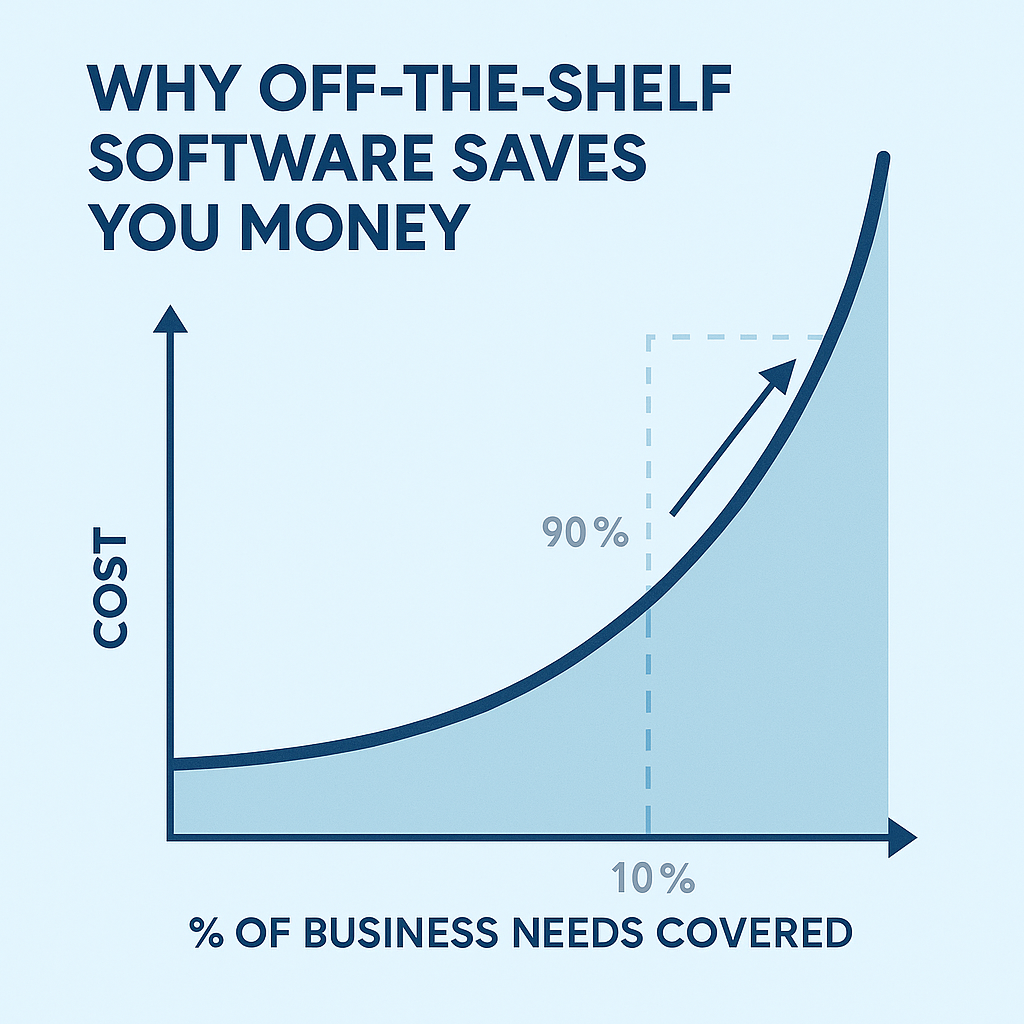
When businesses evaluate software, there’s often a tension between wanting the perfect fit and keeping costs under control. The reality is simple: off-the-shelf (OTS) solutions are cheaper because they cover most needs well — but not every single one.
1. Off-the-Shelf Covers the Core (the 80–90%)
Most organizations share a large set of common requirements: managing staff, reporting, compliance, security. OTS vendors focus on this “shared core.” By standardizing those features, they achieve economies of scale — building once, selling many times — which brings the per-unit cost down dramatically.
📚 Research confirms this: packaged systems reduce development costs by spreading them across the market, but inevitably trade off some customization (Christiawan, 2019).
2. The Missing 10% Is Where Costs Explode
That last 10% — the unique quirks of your business — is the most expensive to build. Every special workflow, report, or integration requires:
- Detailed design
- Custom coding
- Testing and maintenance unique to you
Unlike the shared 90%, these costs can’t be spread across other customers. You shoulder them entirely, which is why custom and enterprise systems cost so much more.
📚 Rikhi (2022) explains that “customized solutions achieve a closer functional fit but escalate in cost exponentially as requirements diverge from the standard.”
3. Adapting the Business vs. Adapting the Software
With OTS, the compromise is simple: your business adapts slightly to fit the system, not the other way around. This isn’t always negative — standardization can streamline processes, improve compliance, and reduce complexity across multiple sites. For franchises in particular, it brings consistency at scale.
4. The Strategic Trade-Off
- Lower cost
- Quicker deployment
- Strong coverage of common needs
- Requires some flexibility from your business
- Perfect alignment with your processes
- Exponentially higher cost
- Longer rollout time
In practice, many businesses find that achieving 90% at a fraction of the cost is the smarter choice — especially when the alternative is spending disproportionately for that final 10%.
✅ In short: Off-the-shelf solutions are not “cheap substitutes.” They’re affordable because they’re shared. The only real question is whether you’re prepared to adapt slightly — because chasing a 100% fit is where costs truly spiral.